
What to Do When Your 11-Year-Old is Behind in Math
TL;DR: What to Do When Your 11-Year-Old Is Behind in Math
Start with a proper diagnostic to pinpoint gaps
Don’t reteach everything; target the most critical skills
Forget grade levels and focus on consistent progress
Avoid long, stressful sessions; keep practice short and frequent
Get professional help early for best results
Emotional support is just as important as academic support
My Eleven-Year-Old Is Going Into 6th Grade and Is Years Behind in Math. What Do I Do?
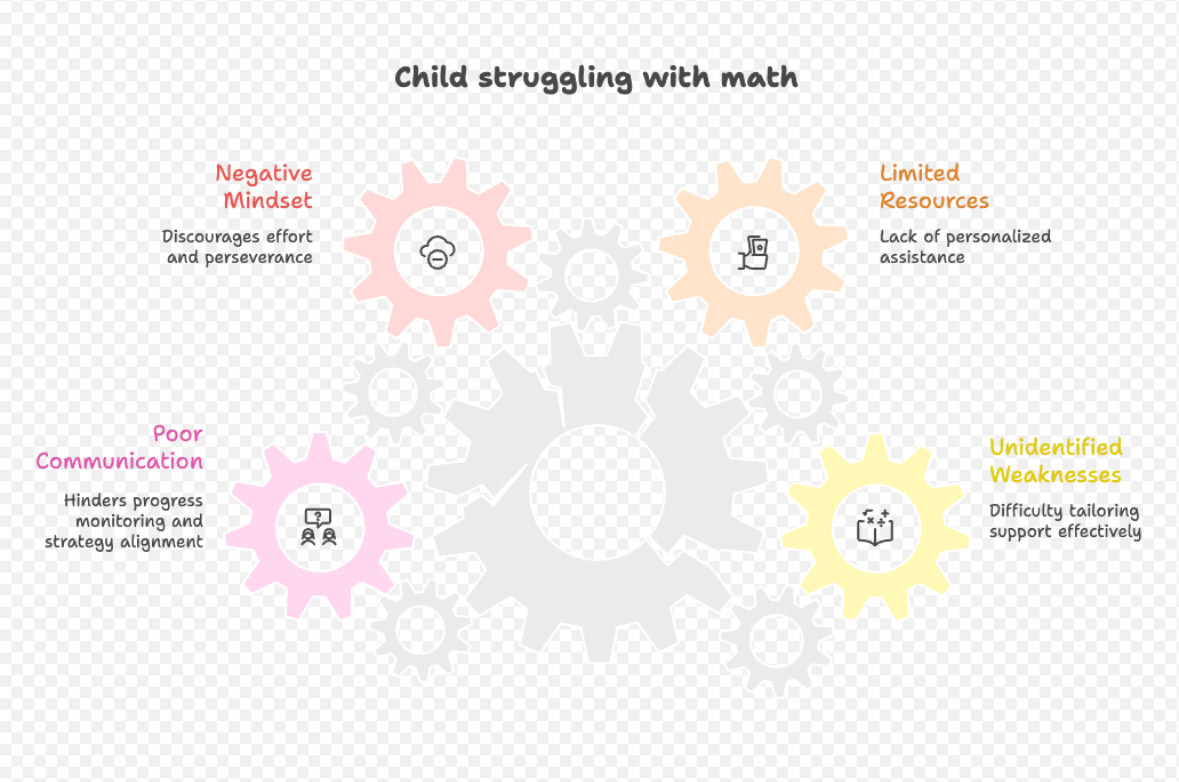
It’s a gut punch no parent wants to feel.
Your child is heading into middle school... and they’re nowhere near ready for grade-level math.
You’re not alone. I work with families across the U.S., especially in education-focused cities like Davis, California, and this is a more common concern than you might think.
And the good news? You can absolutely help your child catch up with the right approach, consistent support, and a clear plan.
Let’s walk through exactly what to do next.
Start With the Right Diagnosis
Before buying a curriculum or hiring a tutor, you need to know why your child is behind.
Here are some common questions to ask:
Are the gaps foundational (e.g., multiplication, place value)?
Are they struggling with specific concepts (like fractions or decimals)?
Is it a matter of speed, confidence, or both?
Could there be a learning issue like ADHD or dyscalculia?
A teacher's report alone won’t give you enough. A quality diagnostic assessment, often done by a trained tutor, can reveal which skills are shaky and which are solid.
Citation: National Center for Learning Disabilities. (2023). The State of Learning Disabilities: Understanding the 1 in 5. https://www.ncld.org
Go Back, But Not Too Far
Parents often ask, "Should I go back to 2nd grade material if my child missed those skills?"
The short answer is: Review the foundations, but don’t waste time reteaching what your child already knows. It’s about precision, not repetition.
For example:
If your child is struggling with fractions, revisit multiplication and division first.
If they’re stuck on long division, review place value and multi-digit subtraction.
Targeted review builds confidence and competence much faster than simply starting over.
Citation: Boaler, J. (2016). Mathematical Mindsets: Unleashing Students' Potential through Creative Math, Inspiring Messages and Innovative Teaching. Jossey-Bass.
Forget Grade Levels. Focus on Progress
"Behind" is a label, not a life sentence.
It’s easy to panic when your child is doing 4th grade math in 6th grade, but learning isn’t always linear. Kids catch up all the time when instruction meets them where they are.
In tutoring, we focus on concept mastery, not grade labels. When that happens:
Gaps close faster
Confidence grows naturally
Students begin to own their learning
In my own practice, I’ve seen students make 1.5 to 2 years of growth in just 6 to 12 months with consistent, focused instruction.
Citation: Robinson, C., Kraft, M. A., Loeb, S., Schueler, B., & Gordon, M. (2022). Accelerating Student Learning with High-Dosage Tutoring. Annenberg Institute at Brown University. https://annenberg.brown.edu/sites/default/files/EdResearch_for_Recovery_Brief_1.pdf
Consistency Beats Intensity
Some families try to cram in extra math sessions during summer or load their child with long homework marathons.
That approach usually backfires.
Instead:
Keep math practice short and frequent - 20 to 30 minutes, 3 to 4 times a week
Focus on active engagement, not passive worksheets
Use strategies like math games, discussion, and problem-solving
This builds fluency and positive habits.
Citation: What Works Clearinghouse. (2021). Assisting Students Struggling with Mathematics: Intervention in the Elementary Grades. Institute of Education Sciences. https://ies.ed.gov/ncee/wwc/PracticeGuide/18
Get Help Early, Not When the Crisis Peaks
Tutoring is most effective before your child has internalized the belief that they’re bad at math.
The earlier you start, the easier it is to:
Rebuild fluency
Close conceptual gaps
Prevent math anxiety
Avoid costly remediation later on
A quality tutor will begin with a diagnostic, create a customized plan, and communicate progress clearly with you as a parent.
Citation: National Tutoring Foundation. (2021). The Case for Tutoring: Evidence and Guidance for Educators. https://www.nationaltutoringfoundation.org
Why I Care So Much About This
A few years ago, I started working with a 6th grader who had completely shut down in math.
She wouldn’t make eye contact when we talked about numbers. Her parents told me she used to love school, but math had become the subject that made her feel “stupid.”
What I saw was a bright, capable kid who had been left behind by a system that moved too fast.
So we slowed down.
We went back to the basics - multiplication facts, place value, and building number sense - but we did it in a way that felt safe.
By spring, she was leading her class in small group math games.
She wasn’t afraid of math anymore, and more importantly, she wasn’t afraid of herself in math.
After 15 years of tutoring middle schoolers, moments like that remind me why I do this work.
Because when a student feels seen and supported, they don’t just catch up. They rise.
Final Thoughts: You’re Not Alone, But You Do Need a Plan
When your 11-year-old is behind in math, it can feel like there’s no time to waste.
But the solution isn’t panic. It’s strategy.
Start with a diagnosis.
Target what matters.
Stay consistent.
Offer emotional safety.
And don’t wait to bring in help.
Behind doesn’t mean broken. It means it’s time to reroute.
Ready to Help Your Child Catch Up in Math?
If your child is behind in math, don’t wait for the next report card to make a change.
Book a free consultation to talk through your child’s challenges and see how personalized support can help them rebuild confidence and skills.
References
National Center for Learning Disabilities. (2023). The State of Learning Disabilities: Understanding the 1 in 5. https://www.ncld.org
Boaler, J. (2016). Mathematical Mindsets: Unleashing Students' Potential through Creative Math, Inspiring Messages and Innovative Teaching. Jossey-Bass.
Robinson, C., Kraft, M. A., Loeb, S., Schueler, B., & Gordon, M. (2022). Accelerating Student Learning with High-Dosage Tutoring. Annenberg Institute at Brown University. https://annenberg.brown.edu/sites/default/files/EdResearch_for_Recovery_Brief_1.pdf
What Works Clearinghouse. (2021). Assisting Students Struggling with Mathematics: Intervention in the Elementary Grades. Institute of Education Sciences. https://ies.ed.gov/ncee/wwc/PracticeGuide/18
National Tutoring Foundation. (2021). The Case for Tutoring: Evidence and Guidance for Educators. https://www.nationaltutoringfoundation.org
About the Author

Libby Oye is a Middle School Math Tutor and founder of Future Scope Tutoring. With over 15 years of experience supporting students across the U.S. and in Davis, California, Libby specializes in helping middle schoolers rebuild confidence, close learning gaps, and rediscover their curiosity in math.