
It’s Not Just Your Kid: The Real Reasons Students Are Falling Behind in Math
TL;DR
Many middle school students struggle in math due to anxiety, missing foundational skills, and difficulty with multi-step problems. Misunderstood issues like processing speed and harmful beliefs like "not a math person" often go unaddressed. With targeted support, all students can improve their math confidence and performance.
It’s Not Just Your Kid: The Real Reasons Students Are Falling Behind in Math
If your child is struggling in math, you’re not the only one feeling frustrated.
In fact, middle school math scores have dropped nationwide - and behind every number is a student feeling lost, anxious, or shut down.
But here’s the truth most schools don’t say out loud:
Kids aren’t failing math.
Math instruction is failing kids.
After 15 years of tutoring middle schoolers in Davis, California and across the U.S., I’ve seen firsthand what’s really holding students back. It’s not laziness. It’s not a lack of potential.
Let’s break down the real reasons middle schoolers struggle - and what we can do about it.
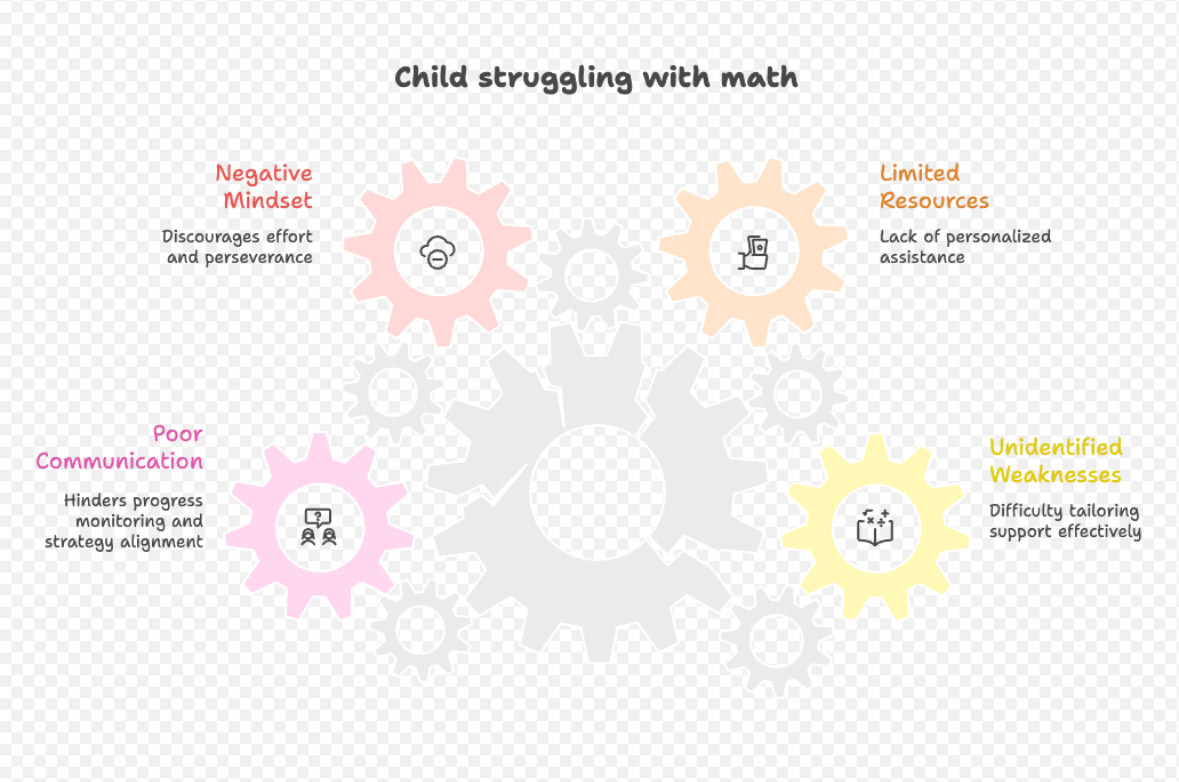
1. Math Anxiety Is Real - and It Starts Early
Middle schoolers often walk into a math class already convinced they’re "bad at math."
By the time they reach sixth or seventh grade, years of confusion, low grades, and public embarrassment (like being called on without knowing the answer) can turn math into a source of stress.
Anxiety affects focus, memory, and risk-taking - all crucial for problem-solving. When a student is nervous, their brain actually struggles to access the very skills they’ve learned.
According to the American Psychological Association, math anxiety affects up to 30% of students and is linked to lower achievement and reduced motivation (Beilock & Maloney, 2015).
What helps:
Creating a judgment-free learning space
Practicing low-stakes problem solving
Celebrating small wins consistently
Tutors who understand math anxiety can rebuild confidence before rebuilding content.
2. Missing Foundational Skills
One of the most common issues I see? Students missing building blocks from earlier grades.
In middle school, students are expected to:
Multiply and divide fluently
Understand place value deeply
Work with fractions, decimals, and percentages
But many still count on their fingers, guess at operations, or panic when they see a fraction.
According to the National Mathematics Advisory Panel (2008), proficiency with whole numbers, fractions, and operations is essential for algebra readiness - yet many students enter middle school lacking these foundations.
What helps:
Diagnostic assessments to find exactly where the gaps are
Focused review (not reteaching full grades)
Connecting old skills to new content
I’ve worked with 7th graders who couldn’t divide but were expected to solve multi-step equations. No wonder they felt lost.
3. Multi-Step Problems Are Overwhelming
Middle school math ramps up in complexity. Students move from basic calculations to multi-step problems that require:
Reading comprehension
Organization
Conceptual reasoning
Stamina
Even students who are okay with basic math may struggle when a single question has five steps, three concepts, and a word problem format.
The Institute of Education Sciences highlights that problem-solving involves both strategic and metacognitive skills - and students need explicit instruction in these areas (IES Practice Guide, 2021).
What helps:
Modeling problems step-by-step
Teaching students how to plan before solving
Using visual supports (number lines, bar models, etc.)
Giving students structured problem-solving routines
Students don't just need to learn math - they need to learn how to approach math.
4. The "Not a Math Person" Myth
Parents often tell me, “She’s just not a math person.”
But here’s what I’ve learned from tutoring hundreds of kids:
There’s no such thing.
What we call “math people” are usually just people who got the right support at the right time.
Believing you’re bad at math becomes a self-fulfilling prophecy. Students stop trying. They avoid challenges. They assume effort is pointless.
Research from Stanford professor Jo Boaler shows that mindset, not innate ability, plays the biggest role in math success. When students believe ability can grow, their achievement improves (Boaler, 2016).
What helps:
Replacing “I can’t” with “I can’t yet”
Showing students how they are making progress
Celebrating effort, not just right answers
Math is a skill - and skills can be developed.
5. "Not Trying Hard Enough" Is a Misdiagnosis
When students shut down in class or rush through their work, it’s tempting to assume they’re not trying.
But many times, I’ve seen something else happening:
They’re overwhelmed and don’t know where to start
They don’t want to look dumb in front of peers
They’re mentally exhausted from trying and failing
Especially with multi-step problems or unfamiliar formats, it’s easier to give up than risk being wrong - again.
What helps:
Scaffolding assignments
Breaking problems into smaller steps
Letting students explain their thinking aloud
Sometimes students aren’t disengaged. They’re burned out from too many missed connections.
6. Schools Often Miss Processing Speed
Even when teachers care deeply and do their best, they may not have time to slow down for students who need more time to process.
Middle school math classes move quickly. Students who need extra time to understand directions, plan their approach, or double-check work can fall behind fast.
And here’s the problem: If they’re slow, but not getting incorrect answers, they may never get the support they need.
What helps:
Reducing time pressure
Giving extra practice with small chunks of content
Letting students talk through their problem-solving
Processing speed isn’t about intelligence. It’s about time - and time is something traditional classrooms don’t always offer.
What Parents Can Do
As a parent, it can be hard to know where to start. You’re juggling school reports, emotional meltdowns, and the pressure to “fix it” fast.
Here’s what I recommend:
Get a diagnostic assessment. Don’t guess where your child is struggling.
Start with consistency. Two or three short sessions per week work better than cramming.
Prioritize confidence. Kids who believe they can learn math will.
Bring in outside support. A tutor who understands middle school math - and middle school brains - can make a huge difference.
Final Thoughts: Every Child Is Capable
After 15 years of tutoring, here’s the truth I come back to over and over:
Every child is capable of doing well in math.
They just need someone to believe in them - and a plan that meets them where they are.
If your middle schooler is struggling, let’s stop blaming them... and start helping them.
Ready to Help Your Child Succeed?
If your child is struggling math, you're not alone or out of options.
Book a free consultation to talk through your child's challenges and learn how personalized tutoring can help them regain confidence and close learning gaps.
References
Beilock, S. L., & Maloney, E. A. (2015). Math anxiety: A factor in math achievement not to be ignored. Policy Insights from the Behavioral and Brain Sciences, 2(1), 4-12.
National Mathematics Advisory Panel. (2008). Foundations for Success: The Final Report of the National Mathematics Advisory Panel. U.S. Department of Education.
Boaler, J. (2016). Mathematical Mindsets: Unleashing Students' Potential through Creative Math, Inspiring Messages and Innovative Teaching. Jossey-Bass.
Institute of Education Sciences. (2021). Assisting Students Struggling with Mathematics: Intervention in the Elementary Grades. https://ies.ed.gov/ncee/wwc/PracticeGuide/18
About the Author

Libby Oye is a Middle School Math Tutor and founder of Future Scope Tutoring. With over 15 years of experience supporting students across the U.S., especially in California, Libby specializes in helping middle schoolers overcome math anxiety, close foundational gaps, and build lasting confidence in their abilities. Her approach is rooted in research-based strategies, personalized learning, and the unwavering belief that every child is capable of succeeding in math.
Keywords: math anxiety, middle school math struggles, help with math, foundational math skills, multi-step problems, math tutor Davis CA, catch up in math, why kids struggle in math, math mindset, processing speed and math